
Your cart (0)
Your cart is empty
Tax included and shipping calculated at checkout
Your cart is empty
Tax included and shipping calculated at checkout

Most RVs are worth 40%–70% of their original price for trade-in, depending on type, age, condition, and market demand. A dealer uses industry data and reconditioning costs to determine the final trade-in value: meaning that number you see online is just a starting point.
If you're wondering whether now is the right time to upgrade, the answer depends on what you're driving, what you want to drive next, and how much equity is sitting in your current rig.
Get Your RV Trade-In Estimate →
The first thing to understand: trade-in value is not the same as private sale value. When you trade in your RV, you're selling it to a dealer who needs to inspect it, recondition it, and resell it for a profit. That margin gets built into your offer.
Dealers focus on one thing above all else: resalability. They're asking themselves:
This is why your trade-in value is always expressed as a range, not a fixed price. A well-maintained 2020 travel trailer might trade for 55%–65% of its original MSRP, while a neglected 2019 Class A could struggle to hit 40%.
Understanding this mindset is the first step to maximizing your RV trade-in value.
Dealers don't pull numbers out of thin air. Here's the simplified formula they use:
Base Market Value
(Reference: J.D. Power RV Values, NADA, recent comps)
– Reconditioning & Repairs
(Interior cleaning, seal repairs, tire replacement, mechanical work)
– Dealer Resale Margin
(Typically 10%–20% of expected resale price)
± Regional & Seasonal Demand
(Spring = stronger offers; oversaturated markets = weaker offers)
= Estimated Trade-In Range
Let's say you own a 2021 travel trailer that originally sold for $45,000:
This is why two identical RVs can receive very different offers depending on timing, location, and dealer inventory needs.
Here's what moves the needle: listed in order of impact:
Class A motorhomes depreciate faster than towables because of their complex mechanical systems. Travel trailers and off-road travel trailers with simpler construction often hold value better. Class B camper vans continue to command premium resale in 2026.
RVs typically lose 10%–20% in the first year and 36%–38% by year five. Quality brands like Airstream, Winnebago, and premium aluminum-frame manufacturers retain 50%–60% after five years.
Water damage, frame rust, and soft floors are deal-breakers. A dealer will discount heavily for structural issues: far more than for cosmetic wear. Structural integrity is the single most important factor for trade-in value, often outweighing expensive upgrades like new awnings or entertainment systems.
For Class A, B, and C motorhomes, engine miles matter. A 100,000-mile diesel pusher faces steeper discounts than a lightly used unit with 30,000 miles.
This one's often overlooked. Units with manageable average travel trailer weights attract more buyers because more trucks can tow them. A compact trailer with a 16 ft camper weight under 3,000 lbs has a larger buyer pool than a heavy 30 ft camper weight requiring a one-ton truck.
Demand varies dramatically. A lightweight 18 ft camper weight trailer commands premium value in urban markets where storage is tight, while larger 24 ft camper weight units perform better in regions with abundant RV parks.
Spring (February–April) is peak trade-in season. Dealers stock up for camping season, creating competition for quality used inventory and stronger offers.
The Bottom Line: If your goal is to upgrade your RV, trade-in is almost always the smarter path. You avoid the headache of private sale negotiations, reduce transaction risk, and can often roll your equity directly into your new rig: sometimes with tax advantages depending on your state.

Online calculators: like those from J.D. Power RV Values and RV Trader: can give you a reasonable range, but they're not final offers. Here's why:
Use online tools to establish a baseline, then get quotes from actual dealers. The difference between an online estimate and a real offer can swing thousands of dollars in either direction.
For a deeper dive into how these calculators work, check out our RV Trade-In Value Calculator guide.
Here's your pre-trade checklist:
A few hundred dollars in repairs can translate to thousands in trade-in value: especially if you're addressing water intrusion or tire safety issues.
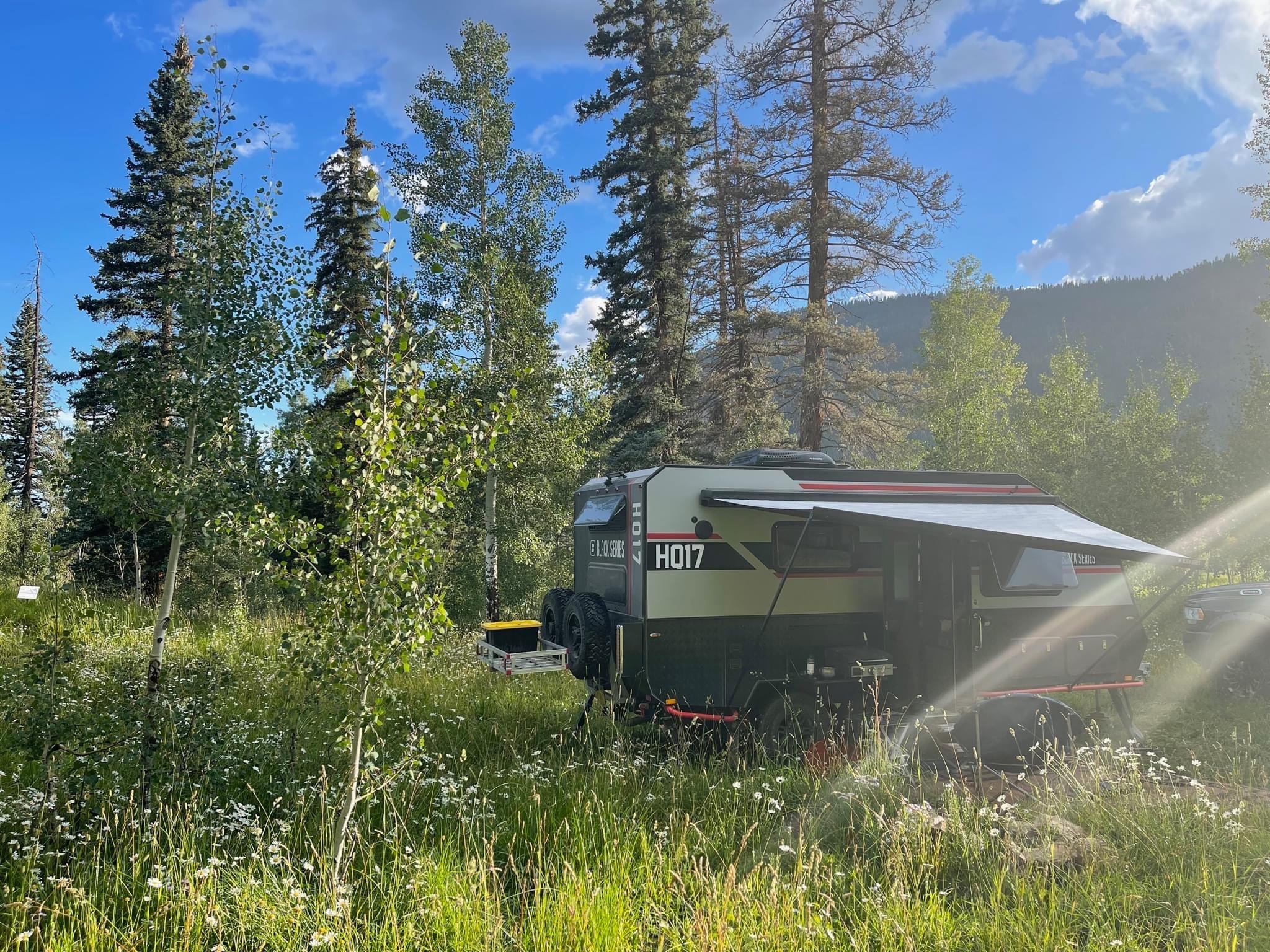
Here's the shift many owners are making: from owning a camper to owning capability.
A standard travel trailer gets you to paved campgrounds. A Black Series off-road travel trailer gets you anywhere: forest service roads, desert boondocking, mountain overlooks that don't exist on reservation systems.
Trading in isn't about getting something "newer." It's about getting something that does more: and holds its value while doing it.
Explore the Black Series RV Trade-In Program →
Most RVs trade for 40%–70% of their original MSRP, depending on type, age, condition, and market demand. Travel trailers typically hold value better than motorhomes due to simpler mechanics.
Trade-in value accounts for dealer reconditioning costs, resale margin, and current market demand. Pandemic-era valuations inflated expectations; the 2026 market has normalized to pre-pandemic levels.
Yes. If you have positive equity, it applies toward your new purchase. If you're underwater (negative equity), the difference can often be rolled into your new loan: though paying down the balance first may be smarter.
Absolutely. Regional demand varies based on climate, camping culture, and local inventory. A dealer in Colorado may offer more for an off-road capable unit than one in Florida.
Yes. Whether you're coming from a Class A motorhome, fifth wheel, or standard travel trailer, Black Series dealers evaluate trade-ins from all major manufacturers. Contact us to start your valuation.
Ready to find out what your RV is actually worth? Whether you're trading a camper, fifth wheel, or Class A motorhome, the upgrade path to off-road freedom starts with a single conversation.
Get Your Trade-In Estimate Today →
Explore the Black Series lineup
Ready for the trail? See the Yellow Stone vs Rocky Mountain editions — and see which build is worth it.
Related reading:
Keep going: Compare all eight models · Black Series guides hub